이슈
2025-10-14 11:55:02 조회수 22
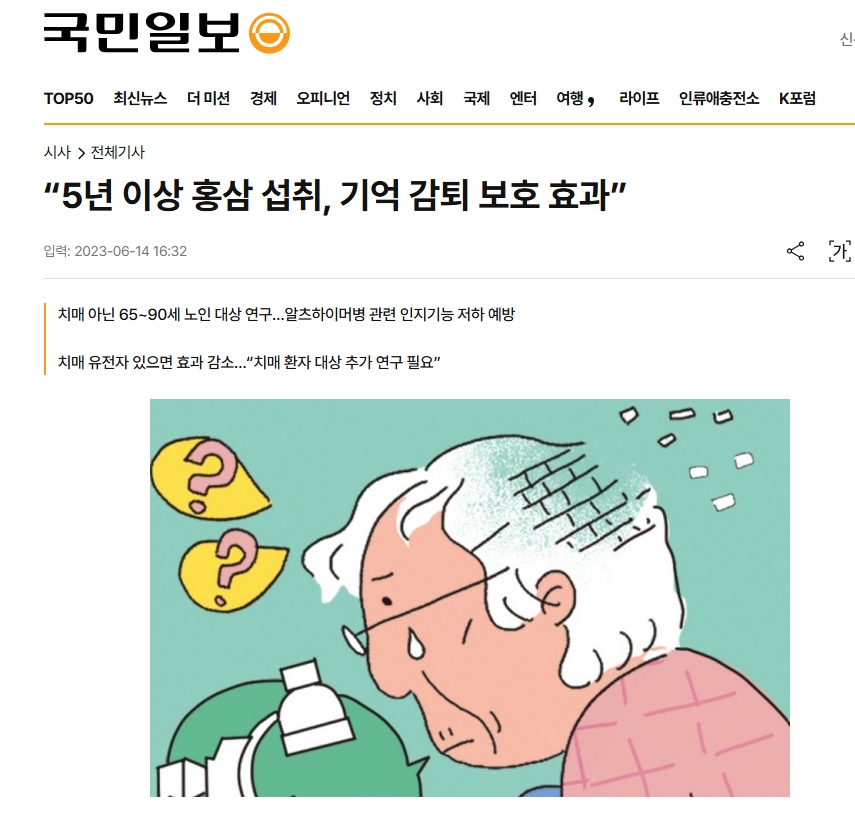
“5년 이상 홍삼 섭취, 기억 감퇴 보호 효과
“Consuming red ginseng for more than 5 years protects against memory decline” [Source] - Kookmin Ilbo
내용
- A study has found that consistently consuming ginseng (red ginseng) for five years or more can prevent cognitive decline caused by Alzheimer's disease.
- A research team led by Professors Kim Ji-wook, Seo Kook-hee, and Choi Young-min of the Department of Psychiatry at Hallym University Dongtan Sacred Heart Hospital, and Professor Kim Hyun-soo of the Department of Laboratory Medicine, examined the association between ginseng and cognitive function and the modulation of apolipoprotein E4 (APOE4), a gene known as the Alzheimer's gene, in 160 elderly individuals aged 65 to 90 without dementia.
- Ginseng intake was systematically assessed, including type, age of first consumption, duration, and frequency.
- A validated nutritional assessment method was also used to analyze dietary patterns based on protein, fruit, and vegetable types.
- Blood tests were also performed to determine the presence of apolipoprotein E4.
- The results showed that most of the ginseng consumed was steamed and dried red ginseng, and that ginseng consumption was found to have a protective effect on episodic memory, a cognitive decline associated with early Alzheimer's disease.
요약
- A study has found that consistently consuming ginseng (red ginseng) for five years or more can prevent cognitive decline caused by Alzheimer's disease.
- A research team led by Professors Kim Ji-wook, Seo Kook-hee, and Choi Young-min of the Department of Psychiatry at Hallym University Dongtan Sacred Heart Hospital, and Professor Kim Hyun-soo of the Department of Laboratory Medicine, examined the association between ginseng and cognitive function and the modulation of apolipoprotein E4 (APOE4), a gene known as the Alzheimer's gene, in 160 elderly individuals aged 65 to 90 without dementia.
- Ginseng intake was systematically assessed, including type, age of first consumption, duration, and frequency.
- A validated nutritional assessment method was also used to analyze dietary patterns based on protein, fruit, and vegetable types.
- Blood tests were also performed to determine the presence of apolipoprotein E4.
- The results showed that most of the ginseng consumed was steamed and dried red ginseng, and that ginseng consumption was found to have a protective effect on episodic memory, a cognitive decline associated with early Alzheimer's disease.
결과 해석 : 연구적 관점
- This page reorganizes publicly available research into a reference summary focused on possible functional relevance.
- Because the source is review-like, it is useful for understanding the overall direction of the literature.
- The findings are best interpreted at a preclinical or exploratory level.
- Functional interpretation should remain cautious because outcomes depend on design, population, and study conditions.
- It is reasonable to interpret the findings together with the broader body of evidence.
결과 해석 : 과학적 관점
- Review papers widen the evidence scope, but differences in the quality of included studies must be considered.
- Animal studies are useful for directionality and mechanism, but cannot be directly generalized to humans.
- Interpretation should remain conservative when endpoints are limited or follow-up is short.
- Confidence improves when findings are consistent with related papers.
- Overall, this material is best used as a research reference rather than as a definitive functional claim.
안내
본 페이지는 공개논문, 특허, 학술자료를 바탕으로 재작성한 참고용 자료입니다.
특정 제품의 예방 또는 치료 효능을 의미하지 않습니다.
특정 제품의 예방 또는 치료 효능을 의미하지 않습니다.