학술자료
2025-10-14 11:43:24
독립적인 혈청 대사체학 접근법은 파킨슨병 환자에서 글루타민산 및 세린 대사가 손상되었음을 확인합니다
Independent serum metabolomics approaches identify disrupted glutamic acid and serine metabolism in Parkinson’s disease patients
내용
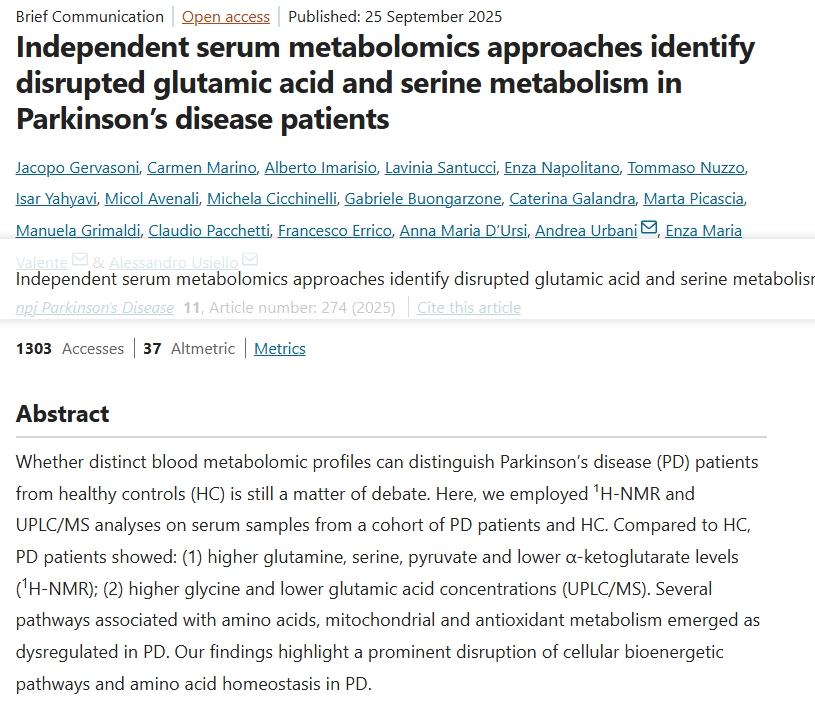
- Whether distinct blood metabolomic profiles can distinguish Parkinson’s disease (PD) patients from healthy controls (HC) is still a matter of debate.
- Here, we employed ¹H-NMR and UPLC/MS analyses on serum samples from a cohort of PD patients and HC.
- Compared to HC, PD patients showed: (1) higher glutamine, serine, pyruvate and lower α-ketoglutarate levels (1H-NMR); (2) higher glycine and lower glutamic acid concentrations (UPLC/MS).
- Several pathways associated with amino acids, mitochondrial and antioxidant metabolism emerged as dysregulated in PD.
- Our findings highlight a prominent disruption of cellular bioenergetic pathways and amino acid homeostasis in PD.
요약
- Whether distinct blood metabolomic profiles can distinguish Parkinson’s disease (PD) patients from healthy controls (HC) is still a matter of debate.
- Here, we employed ¹H-NMR and UPLC/MS analyses on serum samples from a cohort of PD patients and HC.
- Compared to HC, PD patients showed: (1) higher glutamine, serine, pyruvate and lower α-ketoglutarate levels (1H-NMR); (2) higher glycine and lower glutamic acid concentrations (UPLC/MS).
- Several pathways associated with amino acids, mitochondrial and antioxidant metabolism emerged as dysregulated in PD.
- Our findings highlight a prominent disruption of cellular bioenergetic pathways and amino acid homeostasis in PD.
결과 해석 : 연구적 관점
- This page reorganizes publicly available research into a reference summary focused on possible functional relevance.
- Because the source is review-like, it is useful for understanding the overall direction of the literature.
- Human data, when present, can inform applicability more directly.
- Functional interpretation should remain cautious because outcomes depend on design, population, and study conditions.
- It is reasonable to interpret the findings together with the broader body of evidence.
결과 해석 : 과학적 관점
- Review papers widen the evidence scope, but differences in the quality of included studies must be considered.
- Human studies improve applicability, but sample size and comparator design remain important.
- Interpretation should remain conservative when endpoints are limited or follow-up is short.
- Confidence improves when findings are consistent with related papers.
- Overall, this material is best used as a research reference rather than as a definitive functional claim.
안내
본 페이지는 공개논문, 특허, 학술자료를 바탕으로 재작성한 참고용 자료입니다.
특정 제품의 예방 또는 치료 효능을 의미하지 않습니다.
특정 제품의 예방 또는 치료 효능을 의미하지 않습니다.