학술자료
2025-10-11 23:14:10
루게릭병(ALS) 환자를 대상으로 한 L-세린의 안전성에 대한 1상 임상시험 (Phase I clinical trial of safety of L-serine for ALS patients)
Phase I clinical trial of safety of L-serine for ALS patients
내용
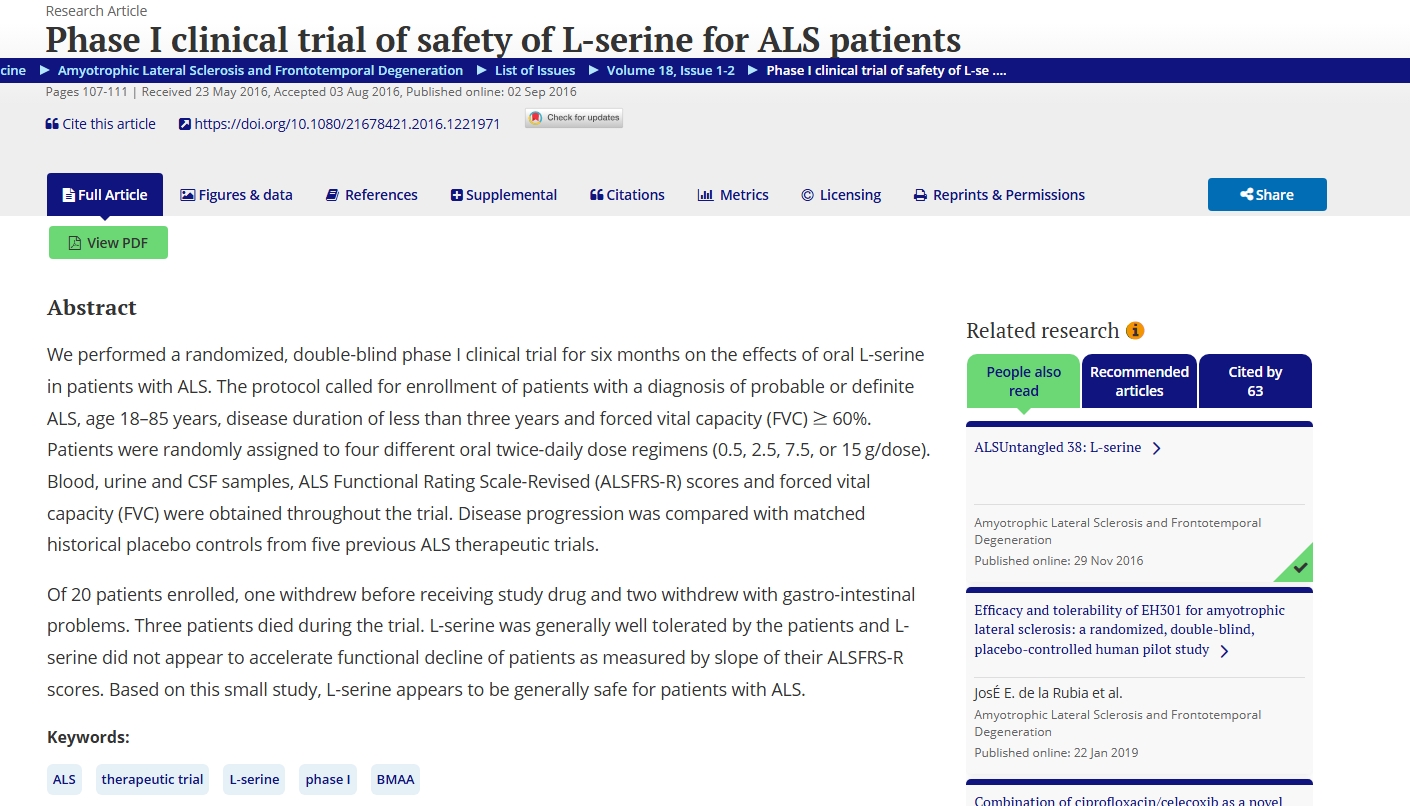
- Abstract We performed a randomized, double-blind phase I clinical trial for six months on the effects of oral L-serine in patients with ALS.
- The protocol called for enrollment of patients with a diagnosis of probable or definite ALS, age 18–85 years, disease duration of less than three years and forced vital capacity (FVC) ≥ 60%.
- Patients were randomly assigned to four different oral twice-daily dose regimens (0.5, 2.5, 7.5, or 15 g/dose).
- Blood, urine and CSF samples, ALS Functional Rating Scale-Revised (ALSFRS-R) scores and forced vital capacity (FVC) were obtained throughout the trial.
- Disease progression was compared with matched historical placebo controls from five previous ALS therapeutic trials.
- Of 20 patients enrolled, one withdrew before receiving study drug and two withdrew with gastro-intestinal problems.
요약
- Abstract We performed a randomized, double-blind phase I clinical trial for six months on the effects of oral L-serine in patients with ALS.
- The protocol called for enrollment of patients with a diagnosis of probable or definite ALS, age 18–85 years, disease duration of less than three years and forced vital capacity (FVC) ≥ 60%.
- Patients were randomly assigned to four different oral twice-daily dose regimens (0.5, 2.5, 7.5, or 15 g/dose).
- Blood, urine and CSF samples, ALS Functional Rating Scale-Revised (ALSFRS-R) scores and forced vital capacity (FVC) were obtained throughout the trial.
- Disease progression was compared with matched historical placebo controls from five previous ALS therapeutic trials.
- Of 20 patients enrolled, one withdrew before receiving study drug and two withdrew with gastro-intestinal problems.
결과 해석 : 연구적 관점
- This page reorganizes publicly available research into a reference summary focused on possible functional relevance.
- Because the source is study-specific, it is useful for understanding the reported findings in context.
- Human data, when present, can inform applicability more directly.
- Functional interpretation should remain cautious because outcomes depend on design, population, and study conditions.
- It is reasonable to interpret the findings together with the broader body of evidence.
결과 해석 : 과학적 관점
- Single studies offer design clarity, but reproducibility still matters.
- Human studies improve applicability, but sample size and comparator design remain important.
- Interpretation should remain conservative when endpoints are limited or follow-up is short.
- Confidence improves when findings are consistent with related papers.
- Overall, this material is best used as a research reference rather than as a definitive functional claim.
안내
본 페이지는 공개논문, 특허, 학술자료를 바탕으로 재작성한 참고용 자료입니다.
특정 제품의 예방 또는 치료 효능을 의미하지 않습니다.
특정 제품의 예방 또는 치료 효능을 의미하지 않습니다.